Something has shifted — and I’ve had to admit it to myself.
For a long time, if I heard something that sounded extreme or outside the mainstream, I dismissed it pretty quickly.
Whether it was people questioning what really happened in events like 9/11 years later, raising concerns about missing details in how school shootings were being reported, or pointing out when certain voices or topics were being censored or restricted online— I assumed it was overblown.
I assumed it was exaggerated or just labeled it as a “conspiracy theory.”
I had people in my life — smart people — who pointed things out years ago, and I didn’t give it much weight.
Part of that was simple.
I think I just didn’t want to believe there was that much deception or darkness operating behind the scenes. I’ve always been a positive person, and I preferred to see the world that way.
But over time, it’s become harder to ignore what’s right in front of my face.
For a lot of people, especially during COVID and in the years since, something started to shift. More questions, more awareness, more willingness to look a little closer.
And once you start to see certain patterns, you can’t really unsee them.
The Way We Consume Information Has Changed
In our parents’ and grandparents’ generation, information was limited.
For the most part, people relied on the news. And what was reported was largely accepted at face value.
That’s no longer the case.
Today, a large percentage of people — especially under the age of 35 or 40 — have all but walked away from mainstream media.
And not without reason.
Over the years, we’ve seen too many examples of incomplete reporting, one-sided narratives, or information that later proved to be misleading or flat-out wrong.
At best, much of it feels surface-level — and that’s no longer enough for people who want to actually understand what’s happening.
So people started looking elsewhere.
Podcasts.
Independent media.
Long-form conversations.
Platforms like YouTube.
And I’m right there with them!
I would say at this point, the majority of what I listen to and learn from comes from these sources.
Yet still, that doesn’t automatically solve the truth problems.
More Access Doesn’t Mean More Truth
One of the biggest challenges now is that we’re constantly trying to answer a question that isn’t always obvious:
Is this actually true…
or is it just quickly labeled a “conspiracy” because it challenges the norm? The reality is that most of our society still has their eyes wide shut!
At the same time, it’s also true that not everything outside the mainstream is credible either.
So now we’re navigating both sides.
And that requires a different level of awareness.
Personally, I’ve had to slow down.
I find myself listening across multiple sources, comparing perspectives, and paying attention to what feels consistent — and what doesn’t.
There’s also a gut check that develops over time.
But that doesn’t happen instantly.
Some of these voices are incredibly convincing. It takes time, attention, and a willingness to not jump to conclusions too quickly.
Admittedly, I’m always working on that instinct.
AI Changed the Game — What You See is Likely Not Real
Technology has added another level of complexity.
There are thousands of comments online that aren’t written by real people. They’re generated to look like real engagement, but they are just computerized bots.
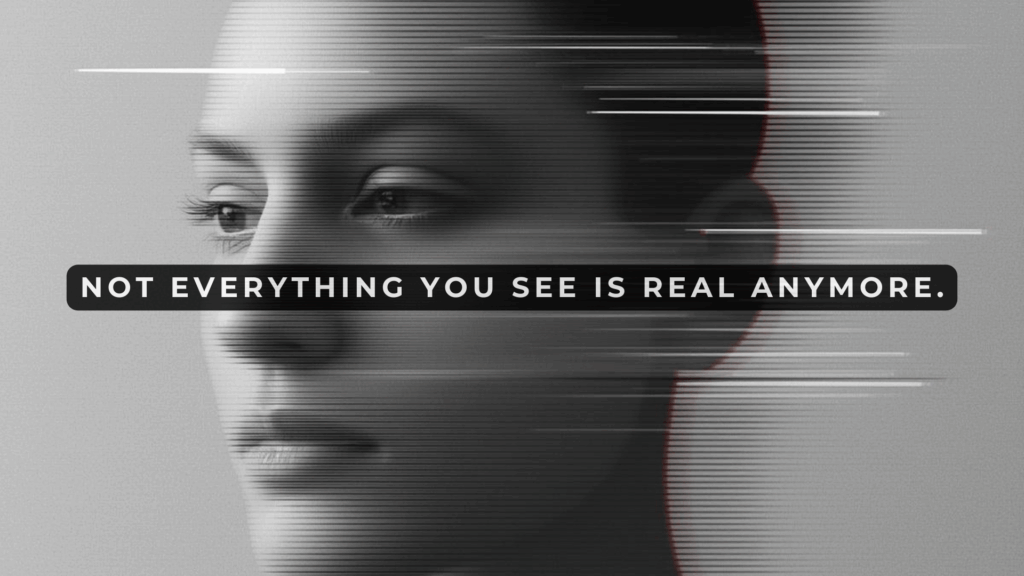
AI can now create videos that look completely real.
Someone could create a video of me — my face, my voice, my mannerisms — even using a background I’ve used before — and make it appear as though I said something I never actually said.
And most people would react before questioning it.
We’ve already seen this happen with public figures like Charlie Kirk and others across both sides.
This isn’t a future concern.
It’s already happening.
The Division We’re Being Pulled Into
There’s also something else that’s becoming harder to ignore.
The level of division.
Right vs left.
Race vs race.
Group vs group.
There’s a constant pull to react, to pick a side, to argue.
And the more we stay focused on each other, the less attention we give to the bigger issues — the ones that actually affect our lives, our future, and the next generation.
That’s not accidental.
And it’s something I’m paying much closer attention to now.
This is something I want to go deeper on in a separate piece, because it deserves more than a mention.
(So stay tuned)
What Discernment Requires of Us
This is where discernment comes in.
Not fear.
Not paranoia.
Because discernment doesn’t mean assuming everything is false or sinister. It means refusing to be lazy with what we believe. It means not reacting immediately just because something sounds convincing, confirms our bias, or triggers a strong emotion.
It means slowing down long enough to ask better questions.
Where did this come from?
Who benefits from this narrative?
Is there actual proof?
What happens when I compare this against other sources?
Does this hold up under scrutiny, or does it just sound compelling in the moment?
Don’t Just Accept. Check.
For me, it also means using the tools available to me. Checking sources. Cross-checking for proof. Using AI tools like Grok when needed to help verify whether something is real, manipulated, or missing context.
And I’ll be the first to admit, I enjoy podcasts and long-form conversations as much as anyone. I can get pulled in too. I’ve had to catch myself more than once from believing something too quickly simply because it was well said, emotionally charged, or sounded intelligent.
So this isn’t about having it all figured out.
It’s about becoming harder to manipulate.
More aware.
More grounded.
Less reactive.
Less easily pulled in every direction by whatever is loudest that day.
Why Stepping Back Matters
The more I sit with all of this, the more convinced I become that stepping back from the constant stream of information is not a luxury. It’s a necessity.
Because if we never step back, we lose more than clear thinking.
We lose sensitivity.
We lose perspective.
We lose our ability to feel when something is off.
We lose the space needed for discernment, prayer, reflection, and real wisdom.
And over time, that kind of constant exposure does something to us. It desensitizes us. It keeps us stirred up, distracted, and emotionally exhausted. It trains us to react instead of reflect, consume instead of contemplate, and argue instead of ask better questions.
That’s what I’m trying to resist.
Not by checking out completely.
Not by pretending none of this matters.
But by becoming more intentional about what I take in, what I trust, and what I allow to shape my mind, my spirit, and my view of reality.
That’s the work.
And I’m still learning how to do it in real time.
Continue the Conversation
If this resonated with you, share it — whether that’s on social or directly with someone who might need it.
I’m hearing from more and more people who are pulling back from the noise and feeling called to something deeper. If someone came to mind as you were reading, send this to them.