Why emotional maturity means letting other people be uncomfortable. And the Three Stages of Owning Your Decisions
Have you ever caught yourself over-explaining a personal belief or a decision you’ve already made?
I’ve always been pretty comfortable speaking my mind. And these days, I care a whole lot less about what people think of me than I did ten or twenty years ago.
But every once in a while, I catch an old habit creeping back in.
Not necessarily because I’m questioning what I said or the decision I made.
Sometimes it’s something much subtler.
I’m uncomfortable because I can sense that the other person is uncomfortable.
I’ll send a direct text…
And then immediately follow it with an emoji.
Or another sentence.
Or something lighthearted to soften what I just said.
Sometimes I’ll quickly change the subject to something easier.
Not because I regret what I said.
Not because I wasn’t clear.
But because I sense that the other person might be uncomfortable.
And suddenly, I’m uncomfortable with their discomfort.
I think that’s an important distinction.
Because over-explaining isn’t always about insecurity or trying to change someone’s mind.
Sometimes it’s an attempt to regulate someone else’s emotions.
And when I do catch myself doing it, I’ve gotten much better at stopping myself and asking why.
When Did Their Discomfort Become Your Responsibility?
I think women, especially, can be very good at smoothing things over.
We soften the text with an LOL or kissy-emoji.
We add, “But totally understand if you feel differently!”
We give three additional reasons for a decision that really only required one.
We sense tension and instinctively try to make it disappear.
Some of that is kindness (maybe).
Some of it is empathy.
And some of it (probably most of it) can come from years of being conditioned to be agreeable, accommodating, and aware of how everyone else is feeling.
For some of us, I think it goes even deeper than that.
Especially if you grew up around chaos, unpredictability, addiction, anger, or violence.
When you’re a child in an unpredictable environment, you learn to read the room.
Closely.
You notice changes in someone’s voice.
You watch facial expressions.
You sense when the energy changes.
You learn who needs to be pleased, who shouldn’t be challenged, when to speak, when to disappear, and how to adjust your own behavior to prevent—or at least prepare yourself for—what might happen next.
That hypervigilance served a purpose in childhood, and perhaps even throughout your teenage years and young adulthood.
It helped you navigate an environment that wasn’t always safe.
And I don’t think the answer is to become less vigilant, discerning, or sensitive to other people. Those qualities can make us perceptive, empathetic, intuitive, and very good at reading a room.
Those are incredibly valuable qualities in a parent, friend, spouse, or leader.
The problem is when noticing someone else’s discomfort causes us to soften our own beliefs, decisions, or boundaries just to make them more comfortable.
That’s the distinction I’ve become much more aware of.
Because noticing someone else’s discomfort doesn’t make it my responsibility to fix it.
That’s something many of us are still learning to let go of.
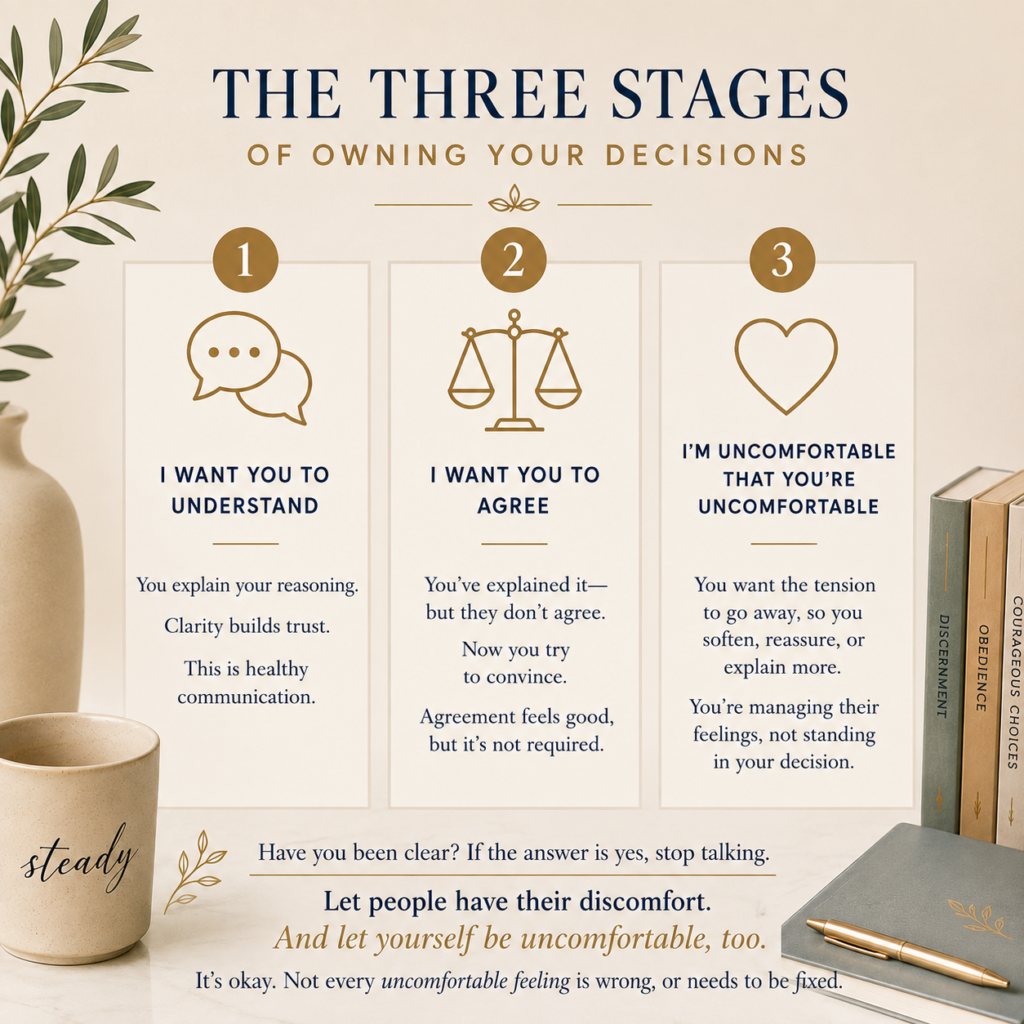
The Three Stages of Owning Your Decisions
I’ve started thinking about this in three stages.
Stage One: I Want You to Understand
This is healthy.
You’ve made a decision and you explain your reasoning.
As a parent, leader, spouse, friend, or business owner, there are plenty of times when people deserve context.
Clarity builds trust.
And thoughtful people should be willing to explain how they arrived at an important decision.
Stage Two: I Want You to Agree
This is where things get interesting.
You’ve explained your decision.
They understand it.
They just don’t agree with it.
So you explain it again.
Maybe you offer another example.
Maybe you give them another piece of information.
Maybe you start building a stronger case.
At this point, you’re no longer explaining.
You’re trying to convince.
You want the other person to see it your way—to validate the decision, the belief, or the boundary you’ve already chosen.
That’s human. We all prefer agreement over pushback.
But here’s the distinction:
Someone else’s agreement doesn’t make your decision right. And their disagreement doesn’t make it wrong.
Stage Three: I’m Uncomfortable That You’re Uncomfortable
This is where it gets more subtle.
You don’t necessarily need the other person to agree with you.
You just want the tension to go away.
You’ve said what you needed to say. You’re still confident in your decision. But you can feel that they’re uncomfortable.
So you soften.
You reassure.
You explain a little more.
Maybe you throw in an emoji or quickly change the subject.
Before you know it, you’re no longer standing in your decision. You’re trying to make the other person feel better about it.
That’s the moment to ask: Am I offering clarity—or am I trying to relieve their discomfort?
Parenting Has Shown Me What This Looks Like
Parenting is actually one area where I’ve become very good at letting other people be uncomfortable with my decisions.
That wasn’t always the case.
Earlier in my parenting years, I was more likely to explain or qualify some of our choices, especially when they were different from what other parents were doing.
But as the years have gone on, I’ve become increasingly confident in how we parent.
My husband and I have made some decisions that aren’t especially common today.
Our 16-year-old daughter doesn’t have a smartphone.
She isn’t permitted to use social media.
We monitor her laptop and restrict computer use at home.
We don’t allow sleepovers outside of our home.
There are other boundaries we’ve put in place that some parents consider strict.
And I’m okay with that.
We’ve thought deeply about these decisions. We’ve considered what we know from experience, what we know about our daughter, about our responsibilities as her parents, and the long-term consequences of what she is repeatedly exposed to and the environments that influence her.
So if someone says:
“She still doesn’t have a smartphone?”
And then there’s a look.
Or a pause.
Or a question.
Of course, I could start piling on the disclaimers:
We’re not judging what anyone else does…
Every child is different…
She’s a great kid…
It’s just what works for us…
But I don’t do that!
I will definitely explain our reasoning when someone is genuinely interested. I can listen to another parent’s perspective. I can even understand why someone might make a completely different choice.
But I no longer soften my decisions to make it more comfortable for someone else.
We Do It With Bigger Decisions, Too
The same dynamic shows up everywhere.
You leave a successful career.
Turn down a promotion.
Start a business.
Stay home with your children.
Change your beliefs about something you once felt certain about.
Become more serious about your faith.
Take an unpopular position on a cultural or political issue.
You make the decision.
You explain why.
Someone doesn’t agree.
And then you start justifying your choices or over-explaining.
I know I’ve done this.
And there is an important distinction here: I’m not suggesting we stop having thoughtful conversations or trying to persuade people.
I like healthy debate.
I think we should challenge one another.
I’ve changed my mind about plenty of things because someone was willing to make a strong argument that caused me to think differently.
That’s not what I’m talking about.
I’m talking about the moment when the conversation is essentially over…
but we keep making our case because we can’t tolerate leaving the room without consensus.
There is a difference between engaging someone thoughtfully and needing them to come around to your side.
You Can Be Kind and Still Let Someone Be Uncomfortable
This may be the biggest shift for me.
I don’t want to become less sensitive to people.
I don’t want to stop noticing how others feel.
And I certainly don’t aspire to become someone who says, “I don’t care what anyone thinks.”
I do care (about them as a person).
I just don’t care about every one of their opinions.
I also don’t think caring requires me to manage anyone else’s response to my decisions.
Those are different things.
You can listen to someone’s disagreement without immediately defending yourself.
You can disappoint someone without having done something wrong.
You can allow someone to misunderstand you.
And you can love someone deeply without making their emotional comfort your responsibility.
For those of us who learned very early to monitor the emotional temperature of a room, that can take some practice.
The goal isn’t to become less aware.
It’s to become more grounded in ourselves despite what we notice.
Pay Attention to the Extra Explanation
Here’s the practice.
The next time you catch yourself adding one more explanation, softening something you didn’t need to soften, or trying a little too hard to make someone understand, pay attention.
Ask yourself:
Have I been clear?
If the answer is yes, stop talking.
You can be thoughtful.
You can be empathetic.
You can remain open to new information.
And you can still let someone disagree with you.
Sometimes maturity is simply knowing when you’ve said enough.
Let people have their discomfort. And let yourself be uncomfortable, too. It’s okay. Not every uncomfortable feeling is wrong, or needs to be fixed.