Why the Strategies That Built Your Life Eventually Stop Working
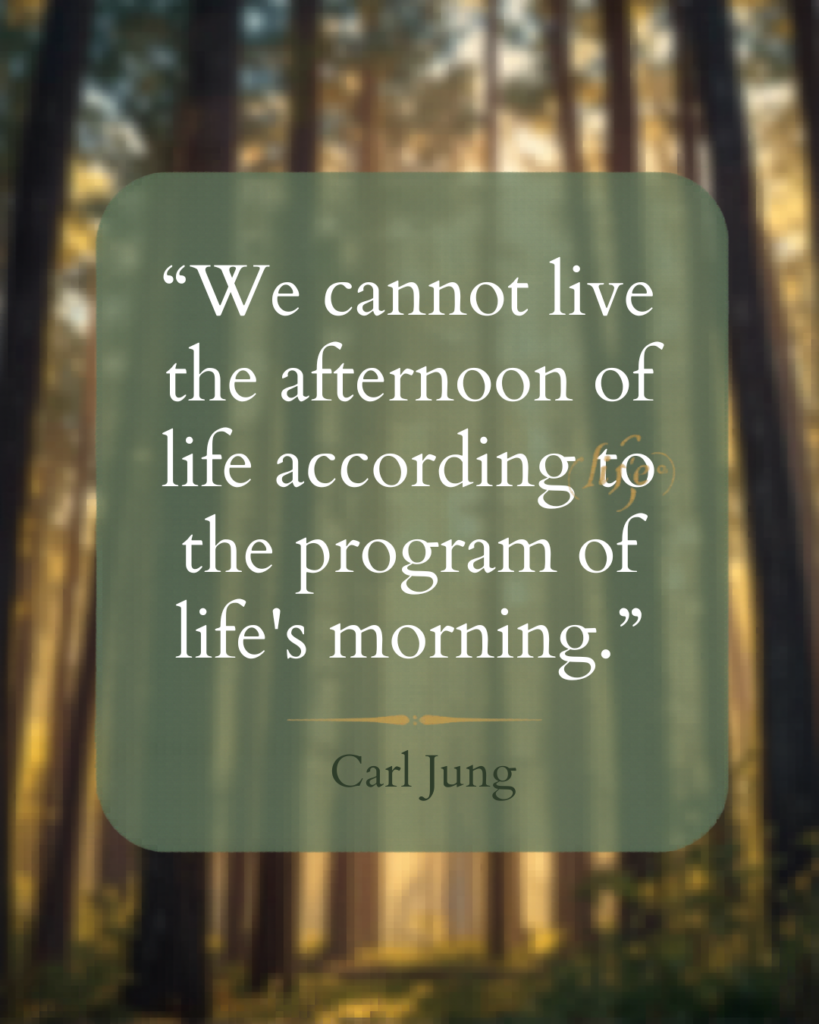
Swiss psychologist and thinker Carl Jung believed a lot of people struggle in midlife for one reason:
They keep trying to live the second half of life with the energy, goals, and identity of the first half.
As I’m approaching my 50th birthday in a few weeks, I find myself understanding more deeply what he meant.
Because something has shifted in me over the last couple of years in a way I never could have fully understood until I lived through it myself.
Late 2024 was really the beginning of it.
In 2025, I intentionally cut my work back by 75%.
And now, here in 2026, I’m essentially on a full sabbatical. Maybe even a temporary “retirement”, at least from the way I used to operate professionally for most of my adult life.
And what’s surprised me most is this:
I have genuinely enjoyed this last year of my life immensely.
Not tolerated it.
Not “needed” it because I was burned out.
Not escaped into it.
Actually enjoyed it.
Deeply.
Sometimes the Things We Once Loved Begin to Feel Different
That realization alone has been confronting for someone like me.
Because for most of my life, I have loved building. Producing. Leading. Competing. Achieving. Creating. Hosting. Performing at a high level.
And even now, I still love many of those things.
I still love training.
I still love a beautiful gathering.
I still love meaningful work.
I still love helping people transform their lives.
But lately, every time I tried turning those things back into a front-facing performance or achievement pursuit again… something inside me resisted.
The Difference Between Desire and Obligation
This year, I thought I would probably:
- go back to social media, after my 30 day fast (it’s been 5 months)
- throw a huge 50th birthday celebration,
- maybe even return to bodybuilding competition
But every time I made a move toward one of those, it felt strangely forced.
Not because I suddenly dislike those things.
Not because I’m “above” any of it now.
But because I slowly realized:
I was trying to move toward them mostly because I felt like I should.
Because those things used to define me.
Because they mattered deeply to me before.
Because people expected it.
But inwardly?
It no longer felt aligned with the season I’m actually in.
And that was difficult to admit at first.
Especially as someone who spent decades operating in high-performance environments.
Midlife Often Requires Different Energy
Jung described the first half of life as largely focused on building:
identity,
achievement,
career,
family,
success,
visibility,
proving.
But he believed the second half of life asks entirely different questions.
What actually matters now?
What feels true?
What feels peaceful?
Who are you when you stop performing for the world?
I think many people feel this transition beginning in midlife but resist it because they mistake it for losing ambition, losing relevance, or “slowing down.”
Jung also believed modern people were becoming psychologically unwell partly because they had become spiritually disconnected and overly focused on productivity, rationalism, performance, and material success.
He believed many emotional struggles were actually deeper spiritual struggles underneath:
a loss of meaning,
a loss of connection,
a loss of inner life.
The older I get, the truer this becomes.
Because the more people I have worked with, the more I have come to believe that most people are not simply exhausted from doing too much.
I think many people are exhausted from living too disconnected from themselves, from God, from nature and stillness, and from the deeper parts of themselves that constant noise and performance can easily drown out.
Growth Doesn’t Always Look Like Expansion
In this performance-free season of my life, I feel more grounded.
Clear.
Integrated.
More spiritually aware.
More present in my actual life, and in my relationships.
At least for now, I am less interested in competing.
More interested in congruence.
Less interested in visibility.
More interested in truth and discernment.
Less interested in forcing expansion.
More interested in appreciating all that I have now.
I’m starting to see this pattern constantly even in the small amount of private client work I still do.
There’s a noticeable difference between people who are still desperately trying to operate from first-half energy… and those who have started surrendering into their second-half rhythm.
The people gripping tightly to the old pace often seem exhausted, restless, overstimulated, uphill all the time.
And the people who begin accepting the transition don’t become less powerful or productive — they become more present, more connected, more peaceful.
The Bible Speaks About Seasons Too
I’m beyond grateful for this season of my life.
Because living through it myself has changed how I support others navigating changing identities, evolving priorities, grief, spiritual growth, aging parents, shifting family dynamics, marriage changes, health challenges, empty nests, and all the other transitions that tend to surface in this stage of life.
The Bible talks constantly about seasons.
There are seasons to build.
Seasons to sow.
Seasons to harvest.
Seasons to prune.
Seasons to rest.
Seasons to retreat.
Seasons to prepare quietly before something new emerges again.
Most high achievers assume that growth only looks like expansion.
More output.
More visibility.
More goals.
More momentum.
But I’m learning that sometimes growth looks like pruning too.
Sometimes it looks like stillness.
Discernment.
Silence.
Pulling back.
Listening more closely.
Letting your nervous system breathe again.
Allowing God to reorder your desires.
That’s part of what makes these transitions so uncomfortable for people.
Because when you’ve spent decades identifying with productivity, achievement, visibility, performance, or momentum, it can feel deeply disorienting when your spirit begins asking for something different.
Not because you’re losing your drive.
Not because you’re becoming less capable.
But because life may be inviting you into a different kind of maturity.
One that values alignment over performance.
Depth over noise.
Presence over proving.
Life asks different things from us in different seasons
And resisting those transitions usually creates suffering — exhaustion, inner conflict, disconnection, restlessness, and the constant feeling that you’re trying to force yourself to keep living a life that no longer fully fits.
If this resonated with you, I’d love for you to share it with someone else who may be quietly navigating a similar season of life right now.